
School of Advanced Technologies for Translators 2019, Milan, Italy
Half-day practical course on post-editing
PART 1
After looking at various standard industry guidelines for light and full post-editing, half the attendees will translate short texts from various languages into English or vice versa and the other half will full-post-edit machine-translated versions of the same texts. The two groups will then come together in pairs according to language combination to compare the results, along with the speaker, both in terms of productivity increase and overall quality.
PART 2
In the second part of the Lab, all the attendees will receive a machine-translated text to post-edit from Italian or Spanish into English, or vice versa. While they are doing so, they will also be asked to use any knowledge they may have of how machine translation works to attempt a preliminary categorization of the errors they find. The speaker will then present an analysis of the errors in the raw outputs, as well as other typical errors which occur, in order to provide practical tips for post-editors. Most of the error types analysed are language-independent and attendees who do not normally work with Spanish or Italian but are familiar with a Neo-Latin language are still likely to find the practical exercise useful.
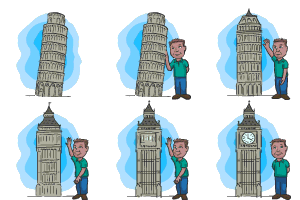 Engaging copy translated literally into English, without taking account of differences in linguistic, semantic and cultural expressions, at best leaves much to be desired and at worst provokes hysterical laughter.
 Thanks to my scientific background, I specialize in technical translations. Over the years I have acquired experience in transcreating advertising copy and press releases primarily for the promotion of technology products.
 All my clients are satisfied with the quality/price ratio of my service.

